
Track List
1 American Salute · Joseph Wilcox Jenkins · 4:55
2 Shenandoah · arr. Hoyt Bohannon · 3:57
3 Nich Yaka Misyachna (The Night is So Moonlit) · Mykola Lysenko · 4:24
4 Dolce Nemica Mia · Giovanni Gabrieli · 2:38
5 O Salutaris Hostia · Ēriks Ešenvalds · 3:24
6 Pavane · Gabriel Fauré · 6:15
7 Ezekiel Saw de Wheel · arr. Moses Hogan · 3:08
8 Elijah Rock · arr Moses Hogan · 3:10
9 Trilogy · Peter Strohm · 10:48
10 Tales of Brynmor · Casey Martin
I Hymn of the Iron Core · 3:55
II Galehaven · 2:46
III Floodhaunt · 5:45
Credits
Benjamin Hay, Richard Rulli & Mary Thornton - Trumpets
Dan Hinman & Brian Scarborough - Tenor Trombones
Andy Newbegin - Bass Trombone
David Swanson - Tuba
This album was recorded at Swarthout Recital Hall on the campus of the University of Kansas in Lawrence, Kansas
Production - William Klimas
Engineering - Andy Newbegin & Steve Riley
Editing - Andy Newbegin
Music Arranging - David Swanson
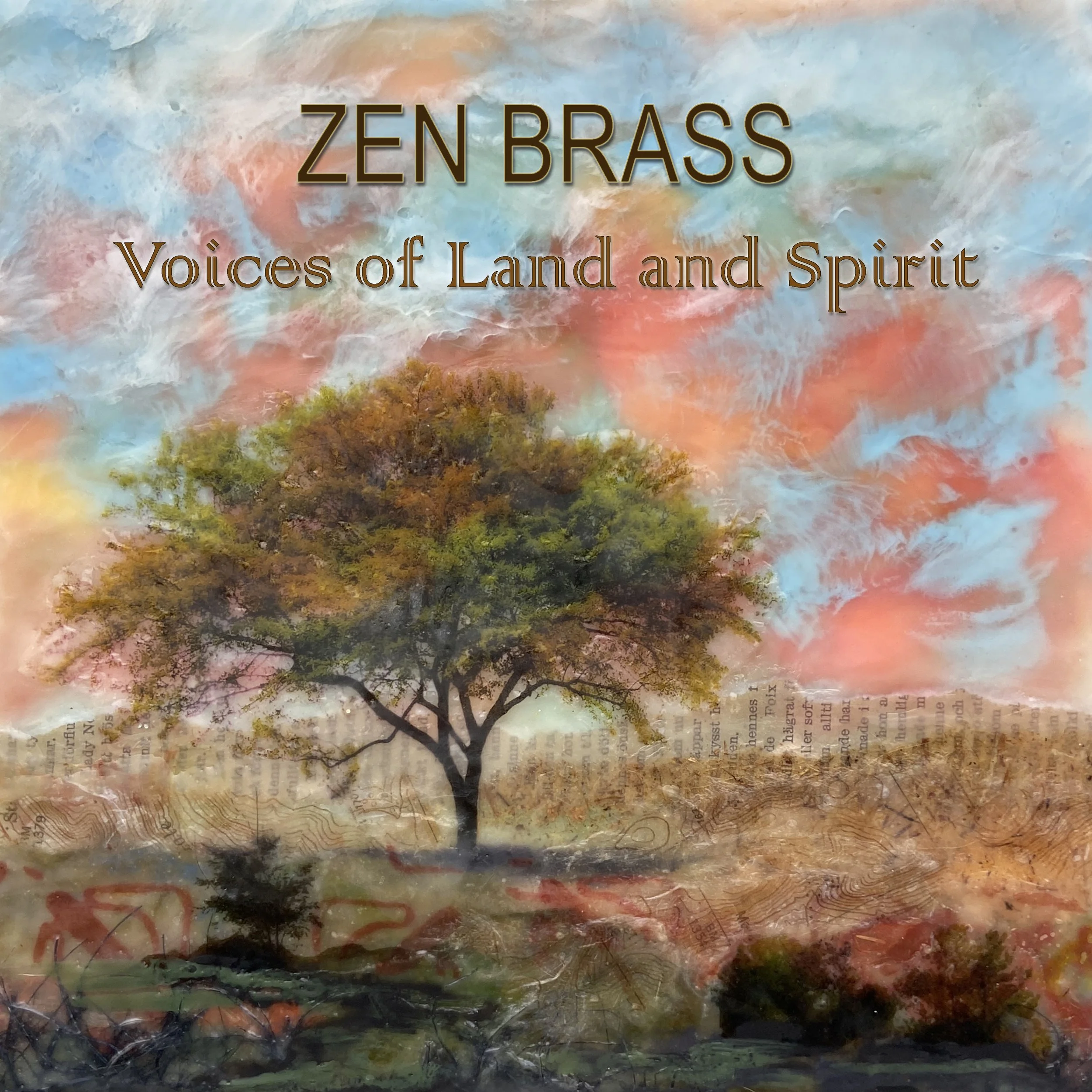
Cover Art Work and Design - Merry Ryding - https://www.mrydingartworks.com/
Arranging and Recording Permissions Granted By:
American Salute - Theodore Presser Company
O Salutaris Hostia - Muzika Baltica
Ezekiel Saw de Wheel - Hal Leonard Corporation
Elijah Rock - Hal Leonard Corporation
Trilogy - Pete Strohm Music
Tales of Brynmor - CCM Music
All other titles are in the public domain.
Ⓟ & Ⓒ 2026 Zen Brass. All Rights Reserved.
Music Notes
Every piece on this recording began somewhere else — a Venetian basilica, a Ukrainian art song, a contemporary choral hymn, a French salon, the cotton fields of the American South, a living composer's imagination. Zen Brass brought them together not because they share a lineage, but because each one, in its own way, speaks to the land beneath us and the spirit that moves through it.
The album opens with Joseph Wilcox Jenkins' American Overture for Band, recast here for septet. Jenkins wrote it in 1953 for the U.S. Army Field Band, where he served as an arranger — his first work for band and still his most performed piece. Its melodic material sits right on the edge of the folk-tune idiom — nothing borrowed outright, but everything shaped by the sound of American folk music; that open, unresolved brightness of a wide horizon. It's the sound of land before it has a name: no specific place, no direct quotation, just the harmonic feel of open country distilled into a few musical gestures. In the original, the piece's most famous moment belongs to the horn section — an octave leap right out of the gate. Here, that leap belongs to one voice alone: the trombone, carrying the full weight of that opening gesture. In a septet, that same audacity sharpens: seven voices doing the work of forty, every entrance more exposed, every line more urgent — the confident, wide-open optimism of the original, distilled down to its essentials.
From there the album settles into Shenandoah, a folk song old enough that no one is certain where it began — a river trader's call, a riverboat song, a ballad of longing for a place left behind. This arrangement carries its own history: Hoyt Bohannon, a Los Angeles studio trombonist who'd played with Harry James and was on staff at Warner Brothers, started a weekly gathering of Los Angeles trombonists, just to keep the group's chops sharp between studio calls. It found a permanent home in a room off Bohannon's garage in North Hollywood, and "Hoyt's Garage" became a Tuesday-night institution — a rite of passage for the city's top trombonists, who read through Bohannon's arrangements of symphonic, choral, and film music for decades. This version reimagines his Shenandoah, originally for seven trombones, as three flugelhorns, three trombones, and tuba — trading some of that dense weight for something warmer and more vocal, letting the melody drift and breathe the way the river itself does.
Mykola Lysenko's The Night Is So Moonlit — in Ukrainian, "Ніч яка місячна" ("Nich yaka misiachna"), is set to an 1870 poem by Mykhailo Starytsky. The lyrics are simple and intimate: a man coaxes his tired beloved out to a moonlit grove, just for a minute, promising to carry her so her feet won't get wet in the dew, and to keep her warm against a heart he says burns like flame. It's a song tied to land in the most literal sense — grass, dew, moonlight, the physical world underfoot — and in a deeper sense too, the way a place can hold two people together simply by existing beneath them. Lysenko, often called the father of Ukrainian classical music, set it as an aria in one of his operas, but the melody took on its own life and became one of the most beloved folk songs in Ukraine. In recent years, as Ukraine has endured war on its own soil, this song has been sung again and again — by soldiers, by refugees, by strangers standing in solidarity — a quiet reminder that even in hardship, people return to the songs that tie them to their land.
The tone shifts toward the sacred with Giovanni Gabrieli's Dolce Nemica Mia — though "sacred" here is more a matter of style than subject. Gabrieli spent his career as organist at St. Mark's Basilica in Venice, and though this piece sets a secular text — a courtly love poem, the beloved cast as a "sweet enemy" who withholds the mercy her beauty promises — it's written in the same multi-voice, multi-choir idiom as his devotional work, the sound of a composer who thought sacredly even when writing about desire. It belongs here not as an act of worship but as its human counterpart: spirit not as reverence for something beyond us, but as the ache and hope of wanting.
That sense of stillness deepens with Ēriks Ešenvalds' O Salutaris Hostia. Ešenvalds is a Latvian composer, among the most performed choral voices of the last two decades, and this setting of the Eucharistic hymn text is built on the kind of close, slow-shifting harmony that seems to hang in the air rather than move through it. Ešenvalds wrote it in 2009 for the Latvian vocal ensemble Anima Sola, scoring it for a women's choir with two soprano soloists floating above the texture, trading the melody back and forth before settling back into the group. Here, those two soprano lines become a duet for two trumpets, Mary and Rich, stepping forward from the ensemble the same way, then folding back in. There's no text for the brass to carry, but the harmony still does what the words once did: it sits, unhurried, and lets the room go quiet around it.
Gabriel Fauré wrotePavanein the summer of 1887 at Le Vésinet, describing it in a letter, almost dismissively, as elegant but "not particularly important" — a light piece meant for outdoor summer concerts, nothing more. It might have stayed that way, if not for the comtesse Greffulhe, Fauré's patron, and one of the great social figures of Belle Époque Paris. Fauré dedicated the piece to her, and at her urging, expanded it: adding a chorus with a text of romantic verse, dancers in costume, a full staged spectacle performed in her Paris garden. What began as a passing distraction became one of his most beloved works, and it has traveled since through nearly every possible arrangement. What survives every version is the pavane itself: a slow, formal court dance from Renaissance Spain, and the strange melancholy Fauré folds into its stateliness. Three centuries and three composers apart, these last three pieces still occupy the same kind of quiet.
Then the mood turns. Ezekiel Saw de Wheel and Elijah Rock arrive through Moses Hogan's celebrated arrangements of the two spirituals. Both are built around a soaring soprano line, and in this recording that line becomes a showcase for trumpet lead Ben, whose high playing carries the melody above the ensemble the way a solo voice cuts above a choir. Hogan, a New Orleans-born conductor and arranger, built his career reintroducing the spiritual tradition to concert audiences with arrangements that kept every ounce of the original's rhythmic drive and harmonic bite. That drive translates directly to brass — the tuba anchoring a pulse that pushes straight through the ensemble, while Ben's line rides above it, turning reflection into motion, and motion into testimony.
The album closes with two pieces that pull every earlier thread back together.Trilogy began as Peter Strohm's American Landscapes, three movements built around a single idea: the North American continent understood as three broad geographic regions, each carrying its own character. The original movements were titled Urban, Rural, and Untamed. In Trilogy, the final two, Rural and Untamed, merge into a single through-composed movement, unfolding across three tempo markings — Largo quasi in flusso, Moderato doloroso, and Allegro giubiloso. The Largo carries an unmistakably American sound, like Copland's brand of open-prairie optimism. The Moderato turns inward and unsettled, its doloroso marking earning every bit of the sadness and unease it implies. The Allegro giubiloso breaks it open entirely — joyful, propulsive, the kind of music that brings to mind wild horses running loose across open plains.
AndTales of Brynmor, an original composition by Casey Martin, closes the recording in three movements — the album's only piece written for a brass septet specifically, although we change the instrumentation to suit our own. The work draws its story from a Dungeons & Dragons campaign Martin played for years with close friends, set in a richly imagined kingdom called Brynmor. The first movement, "Hymn of the Iron Core," is a solemn theme for the party of adventurers at the story's center — the Iron Core — weighted with the gravity of their quest to defeat the Cult of the Shattered Hand. "Galehaven" follows, named for a town quietly devastated by plague. The final movement, "Floodhaunt," takes its name from the bustling port from which the Iron Core sets sail, leaving Brynmor behind for the treacherous Shattered Lands. Together, Trilogy and Tales of Brynmor close this recording where it was always headed - land and spirit not as two ideas held side by side, but as one continuous story.